
PT-141
Melanocortin-receptor research peptide · Third-party COA on every batch
✓ Third-party verified purity · ✓ ISO/IEC 17025 accredited COA · ✓ US-shipped · ✓ Batch-tested
COA
Third-party Certificate of Analysis, every batch
17025
ISO/IEC accredited testing laboratory
USA
Domestic cold-chain fulfillment
Batch
Independently tested, every batch
Research Use Only (RUO). This article is for educational and informational purposes only. PT-141 and all compounds discussed are intended solely for in-vitro laboratory research and are not for human or veterinary use, consumption, or application. Nothing here is medical advice or a claim of therapeutic benefit.
What Is PT-141?
PT-141 (Bremelanotide) is a cyclic heptapeptide melanocortin receptor agonist derived from Melanotan II through structural modification. Where its parent compound is broadly active, PT-141 was developed as a more selective derivative, and it has become a key reference compound for studying central melanocortin signaling. At Collins Wellness, PT-141 (10mg) is supplied as a lyophilized powder verified to ≥98% purity for in-vitro research use only.
Studied Mechanisms of PT-141 (In-Vitro and Preclinical)
As with all research peptides, the framing matters: these findings come from cell-based and animal models, not human trials. The literature focuses on melanocortin receptor pharmacology.
MC3R / MC4R agonism. PT-141 acts primarily through the MC3R and MC4R melanocortin receptor subtypes expressed in the hypothalamus and limbic system. Importantly, it has reduced activity at peripheral MC1R (the receptor responsible for melanogenesis) compared with Melanotan II, while retaining central MC3R/MC4R activity — a selectivity profile that makes it useful for dissecting central pathways.
Molecular signaling. When PT-141 binds MC4R, it triggers Gs-protein coupling and adenylyl cyclase activation, raising intracellular cAMP, with secondary activation of phospholipase C (PLC) and ERK/MAPK pathways in neuronal systems.
CNS activation. In preclinical models, central melanocortin activation by PT-141 engages the medial preoptic area (MPOA) and paraventricular nucleus. Increased c-Fos immunoreactivity in these hypothalamic regions following administration in rat and primate models provides direct evidence of neuronal activation in the circuits studied.
Broader MC4R biology. Because MC4R also participates in energy homeostasis, feeding behavior, inflammation, and autonomic regulation, PT-141's receptor selectivity makes it a useful tool for isolating these pathways in research.
PT-141 and Related Research Peptides
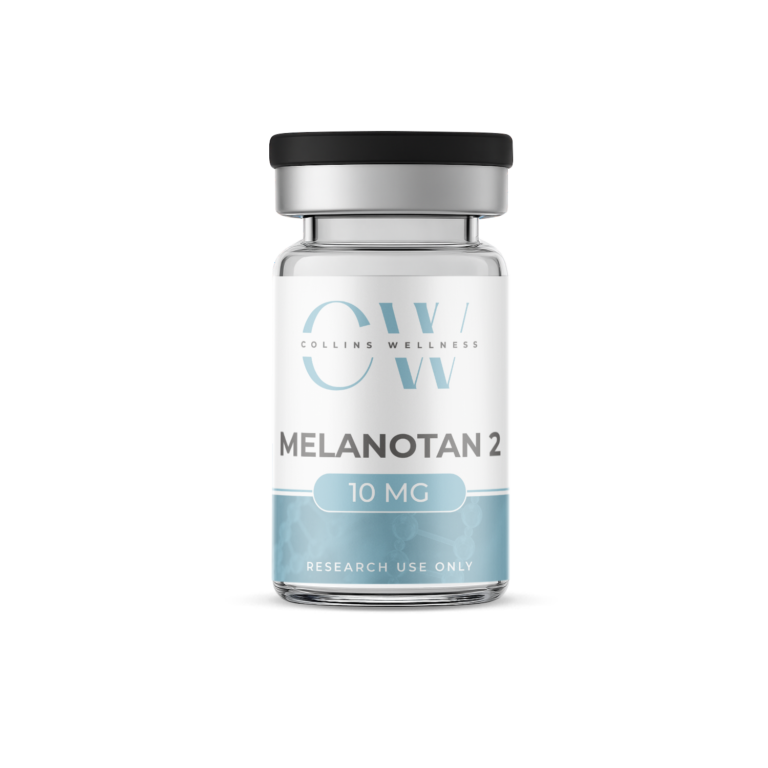
PT-141 is closely related to Melanotan 2, from which it is derived; comparing the two is a common approach for researchers mapping receptor-specific (central vs. peripheral) melanocortin effects. Both appear in the Melanotan Peptides category.
Why Purity Matters
Because PT-141 is studied for receptor-level pharmacology and CNS signaling, impurities such as truncated sequences or residual reagents can distort binding and signaling readouts and undermine reproducibility.Every Collins Wellness peptide is verified to ≥98% purity by third-party testing and documented in a Certificate of Analysis (COA).
Storage and Handling
PT-141 ships as a lyophilized (freeze-dried) powder in sealed, sterile vials. General laboratory practice is to store lyophilized material at approximately -4°F for long-term storage (up to ~24 months) and 36–46°F refrigerated for short-term storage (up to ~3 months), away from light, moisture, and repeated freeze-thaw cycling. Reconstituted peptide is less stable and should be handled per the specific research protocol.
Frequently Asked Questions
What is PT-141?
A cyclic heptapeptide melanocortin agonist (Bremelanotide) derived from Melanotan II, studied for central MC3R/MC4R signaling.
How is PT-141 different from Melanotan 2?
PT-141 has reduced activity at peripheral MC1R (melanogenesis) while retaining central MC3R/MC4R activity, giving it a more central-selective research profile.
Is PT-141 approved for human use?
No. It is not FDA-approved to diagnose, treat, cure, or prevent any disease and is sold strictly for in-vitro laboratory research. All cited data comes from animal and cell-based models.
What purity should research PT-141 have? Explore Further
Browse the Melanotan Peptides category or the complete research peptide catalog, and visit the Collins Wellness Research Peptide Blog for more research guides.
Full Disclaimer: Any mention of research chemicals, peptides, or related compounds is for educational and informational purposes only. These materials are not intended for human or veterinary use, consumption, or application, and are not classified as drugs, dietary supplements, or food products under applicable law. All products are intended solely for in-vitro laboratory research use only (RUO). They are not FDA-approved for human use, diagnosis, treatment, cure, or prevention of any disease. Always consult a licensed professional regarding any health-related questions.
Shop research-grade PT-141
Ships lyophilized with its batch Certificate of Analysis.