CJC-1295 / Ipamorelin
Growth-hormone research peptide blend · Third-party COA on every batch
✓ Third-party verified purity · ✓ ISO/IEC 17025 accredited COA · ✓ US-shipped · ✓ Batch-tested
COA
Third-party Certificate of Analysis, every batch
17025
ISO/IEC accredited testing laboratory
USA
Domestic cold-chain fulfillment
Batch
Independently tested, every batch
Research Use Only (RUO). This article is for educational and informational purposes only. CJC-1295, Ipamorelin, and all compounds discussed are intended solely for in-vitro laboratory research and are not for human or veterinary use, consumption, or application. Nothing here is medical advice or a claim of therapeutic benefit.
What Are CJC-1295 and Ipamorelin?
CJC-1295 and Ipamorelin are two of the most frequently studied research peptides in the growth-hormone (GH) signaling literature, and they are often examined together as a blend. They belong to different peptide classes and act on different receptors, which is precisely why researchers pair them: each stimulates GH release through a distinct pathway. At Collins Wellness, the 2X Blend CJC-1295 (No DAC) / Ipamorelin is supplied as a lyophilized powder verified to ≥98% purity for in-vitro research use only.
CJC-1295: A GHRH Analog
CJC-1295 is a 29-amino-acid analog of growth hormone–releasing hormone (GHRH) — a tetra-substituted derivative of GHRH(1-29). In research models, when CJC-1295 binds the GHRH receptor, it activates adenylyl cyclase, raising intracellular cyclic AMP (cAMP) and triggering a cascade associated with GH synthesis and secretion. In mechanistic terms, it is described as raising the baseline "tone" of GH release.
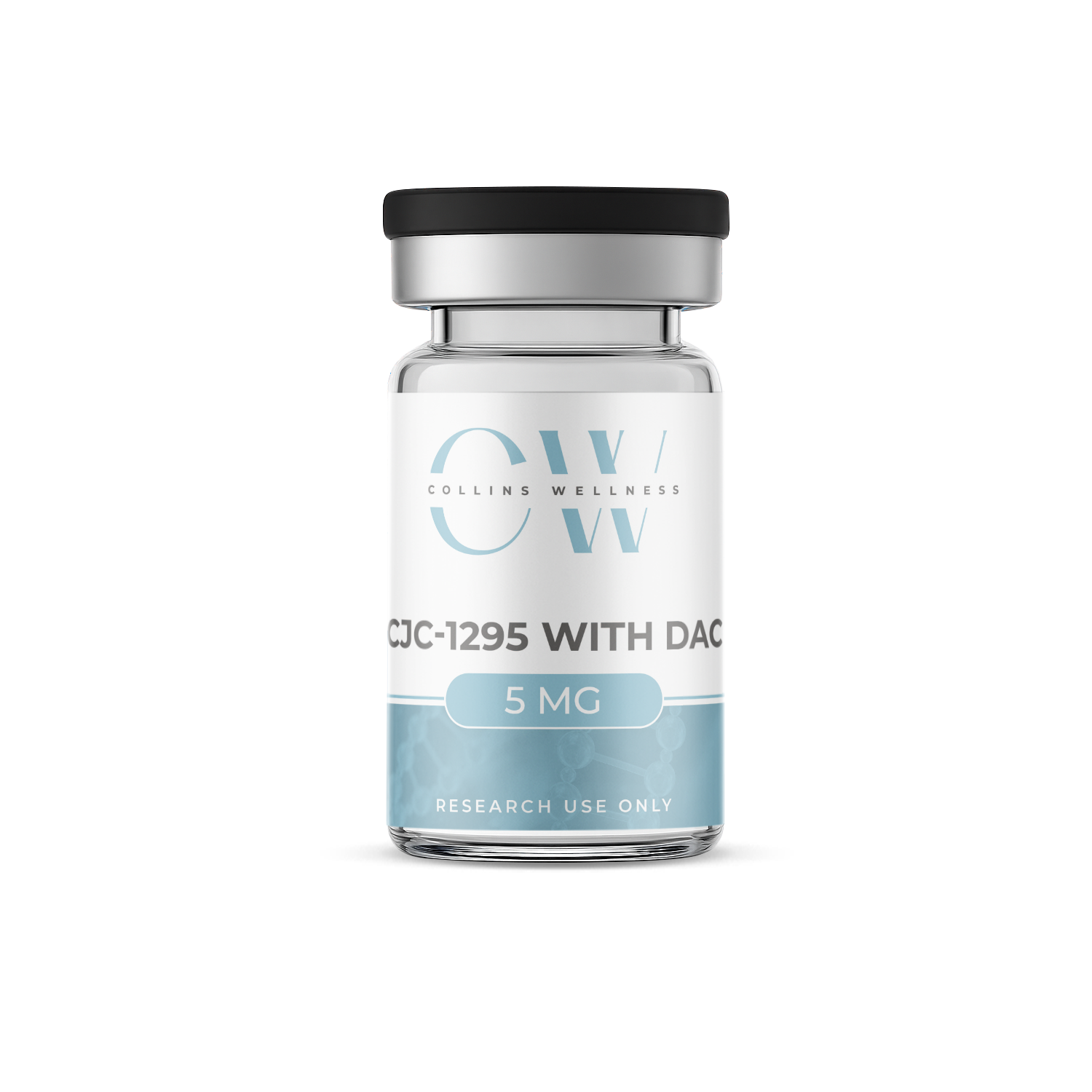
A key research distinction is DAC vs. No-DAC. The DAC (Drug Affinity Complex) version covalently binds to serum albumin, which extends its half-life from minutes to several days in study models. The No-DAC version is shorter-acting, producing a more transient signal. Collins Wellness supplies both the CJC-1295 With DAC and No-DAC formats so investigators can select the profile their protocol calls for.
Ipamorelin: A Selective Growth Hormone Secretagogue
Ipamorelin acts through a different receptor: the growth hormone secretagogue receptor type 1a (GHS-R1a), found in the hypothalamus and pituitary. In preclinical studies it is characterized as a selective secretagogue — it triggers a sharp pulse of GH release from somatotroph cells while, in the reported models, largely avoiding stimulation of other pituitary hormones such as prolactin. That selectivity is why it appears so often in controlled GH-signaling experiments.
Why the Two Are Studied Together
The rationale for the blend is mechanistic complementarity. CJC-1295 acts on the GHRH receptor to raise the baseline tone of GH release, while Ipamorelin acts on the ghrelin/GHS receptor to produce a sharp pulse. Research has reported that simultaneously stimulating both receptor pathways produces a synergistic GH response in study models — greater than the sum of the two individual responses. This dual-pathway design is the mechanistic foundation for studying the combined blend rather than either peptide alone.
Important framing: these observations come from laboratory and animal models. The blend is a tool for studying GH-axis signaling in vitro — not a statement about outcomes in humans, and no such use is implied or endorsed.
Why Purity Matters
Because these peptides are studied for receptor-level signaling, impurities — truncated sequences, deletion peptides, or residual reagents — can distort assay readouts and undermine reproducibility.Every Collins Wellness peptide is verified to ≥98% purity by third-party testing and documented in a Certificate of Analysis (COA).
Storage and Handling
Both peptides ship as lyophilized (freeze-dried) powder in sealed, sterile vials for stability. General laboratory practice is to store lyophilized material at approximately -4°F for long-term storage (up to ~24 months) and 36–46°F refrigerated for short-term storage (up to ~3 months), away from light, moisture, and repeated freeze-thaw cycling. Reconstituted peptide is far less stable and should be handled per the specific research protocol.
Frequently Asked Questions
What is the difference between CJC-1295 With DAC and Without DAC?
The DAC (Drug Affinity Complex) version binds serum albumin and is long-acting (half-life of several days in study models); the No-DAC version is shorter-acting and more transient. Researchers choose based on the signaling profile their protocol requires.
Why are CJC-1295 and Ipamorelin combined?
They act on two different receptors (GHRH receptor and the GHS/ghrelin receptor). In research models, stimulating both simultaneously produces a synergistic GH response greater than either peptide alone.
Are these peptides approved for human use?
No. They are not FDA-approved to diagnose, treat, cure, or prevent any disease and are sold strictly for in-vitro laboratory research. All cited data comes from animal and cell-based models.
What purity should the blend have? Explore Further
Browse the full range in the Popular Peptides category or the complete research peptide catalog, and visit the Collins Wellness Research Peptide Blog for more research guides.
Full Disclaimer: Any mention of research chemicals, peptides, or related compounds is for educational and informational purposes only. These materials are not intended for human or veterinary use, consumption, or application, and are not classified as drugs, dietary supplements, or food products under applicable law. All products are intended solely for in-vitro laboratory research use only (RUO). They are not FDA-approved for human use, diagnosis, treatment, cure, or prevention of any disease. Always consult a licensed professional regarding any health-related questions.
Shop research-grade CJC-1295 / Ipamorelin
Ships lyophilized with its batch Certificate of Analysis.