Epitalon
Telomere and longevity research peptide · Third-party COA on every batch
✓ Third-party verified purity · ✓ ISO/IEC 17025 accredited COA · ✓ US-shipped · ✓ Batch-tested
COA
Third-party Certificate of Analysis, every batch
17025
ISO/IEC accredited testing laboratory
USA
Domestic cold-chain fulfillment
Batch
Independently tested, every batch
Research Use Only (RUO). This article is for educational and informational purposes only. Epitalon and all compounds discussed are intended solely for in-vitro laboratory research and are not for human or veterinary use, consumption, or application. Nothing here is medical advice or a claim of therapeutic benefit.
What Is Epitalon?
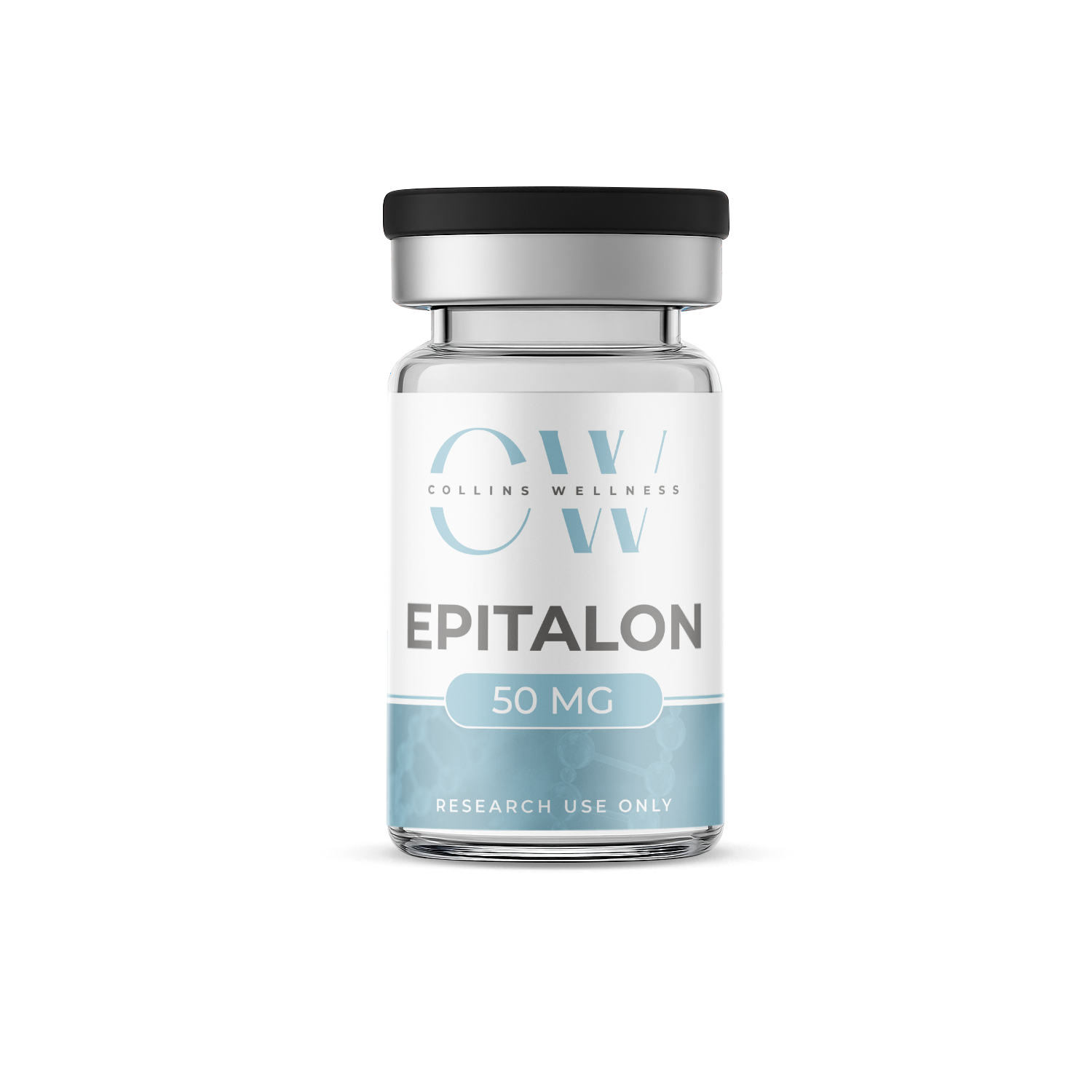
Epitalon (also spelled Epithalon; sequence Ala-Glu-Asp-Gly, or AEDG) is a synthetic tetrapeptide developed as an analog of Epithalamin, a peptide fraction originally extracted from the pineal gland. It was developed by Professor Vladimir Khavinson at the Saint Petersburg Institute of Bioregulation and Gerontology, and it has become one of the most studied "bioregulator" peptides in aging and telomere research. At Collins Wellness, Epitalon (10mg) is supplied as a lyophilized powder verified to ≥98% purity for in-vitro research use only.
Studied Mechanisms of Epitalon (In-Vitro and Preclinical)
As with all research peptides, framing matters: these findings come from cell-culture and animal models, not human trials. With that caveat, the literature centers on a few well-documented themes.
Telomerase activation. The most-cited mechanism is telomerase activation. In cultured human cells, Epitalon is reported to induce the telomerase catalytic subunit (hTERT) and telomerase activity, which can elongate telomeres. The effect appears to involve up-regulation of TERT mRNA expression rather than direct enzymatic interaction; whether this is a direct or indirect (upstream-signaling) effect is not yet definitively established.
Extended replicative capacity in vitro. In a widely cited study, Khavinson and colleagues (2003) reported that Epitalon treatment activated hTERT expression and extended replicative capacity by roughly 42% in human fetal fibroblast cultures. In these models, treated cells surpassed their normal "Hayflick limit," continuing for additional divisions compared with controls.
Telomere normalization. In aging human fibroblast cultures, Epitalon has been reported to normalize telomere length in cells that had undergone progressive shortening — a key reason it appears so often in cellular-aging research.
Pineal / melatonin research. Given its pineal origin, some preclinical studies have examined whether Epitalon influences melatonin production, particularly in aged animal models where pineal function naturally declines.
Epitalon and the Bioregulator Family
Epitalon belongs to a broader class of short "peptide bioregulators" studied for tissue-specific signaling. Researchers often study it alongside related compounds in the Bioregulators category, and Collins Wellness also offers the N-Acetyl Epitalon Amidate, a modified form studied for altered stability characteristics.
Why Purity Matters
Because Epitalon is studied for effects on gene expression and telomerase activity, impurities such as truncated sequences or residual reagents can confound sensitive molecular readouts and undermine reproducibility.Every Collins Wellness peptide is verified to ≥98% purity by third-party testing and documented in a Certificate of Analysis (COA).
Storage and Handling
Epitalon ships as a lyophilized (freeze-dried) powder in sealed, sterile vials. General laboratory practice is to store lyophilized material at approximately -4°F for long-term storage (up to ~24 months) and 36–46°F refrigerated for short-term storage (up to ~3 months), away from light, moisture, and repeated freeze-thaw cycling. Reconstituted peptide is less stable and should be handled per the specific research protocol.
Frequently Asked Questions
What is Epitalon?
It is a synthetic tetrapeptide (Ala-Glu-Asp-Gly / AEDG), an analog of the pineal peptide Epithalamin, widely studied in telomere and cellular-aging research.
How does Epitalon work in research models?
Its most-cited mechanism is up-regulating hTERT (telomerase) expression, which in cultured cells is associated with telomere elongation and extended replicative capacity. All evidence is preclinical.
Is Epitalon approved for human use?
No. It is not FDA-approved to diagnose, treat, cure, or prevent any disease and is sold strictly for in-vitro laboratory research.
What purity should research Epitalon have? Explore Further
Browse the Bioregulators category or the complete research peptide catalog, and visit the Collins Wellness Research Peptide Blog for more research guides.
Full Disclaimer: Any mention of research chemicals, peptides, or related compounds is for educational and informational purposes only. These materials are not intended for human or veterinary use, consumption, or application, and are not classified as drugs, dietary supplements, or food products under applicable law. All products are intended solely for in-vitro laboratory research use only (RUO). They are not FDA-approved for human use, diagnosis, treatment, cure, or prevention of any disease. Always consult a licensed professional regarding any health-related questions.
Shop research-grade Epitalon
Ships lyophilized with its batch Certificate of Analysis.